Podcasting
BY Sarah Patterson June 25, 2026
Podcasting October 13, 2025
Podcasts without truth and accuracy can pollute the public sphere: SXSW Sydney
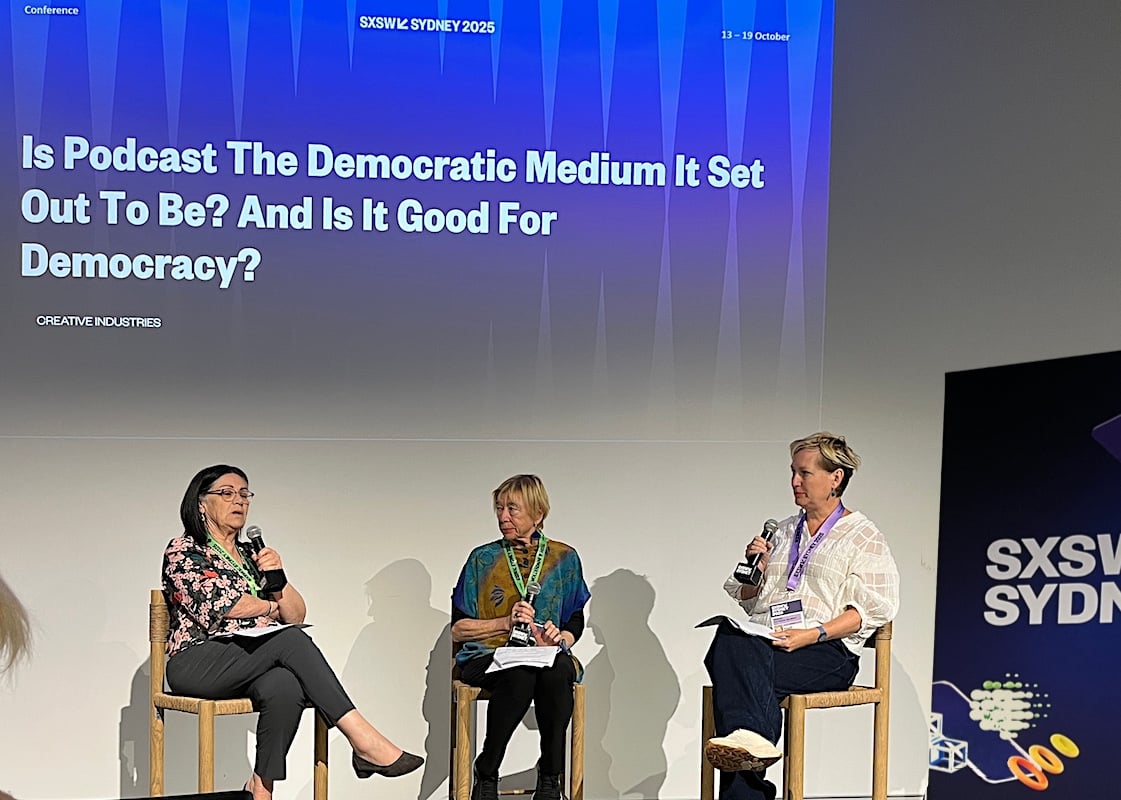
“Through Podcasting, independent voices can find their way into the mainstream,” said Monica Attard, in one of this week’s podcasting conference sessions at SXSW Sydney.
“The audience for podcasts are very engaged, especially politically engaged, but are podcasts the democratic force we thought they could be?” asked session host Sarah Gilbert from Impact Studios, prompting discussion about the difference between the ideals and the reality of podcasting now that it is a mature form of audio media.
The original intention of podcasting was to “create an open medium, not to make money,” said Siobhan McHugh, referencing RSS podcast feed developer Dave Winer. “But that has since been undermined by corporates like Spotify putting content behind paywalls, that’s tragic. Open podcasting has encouraged many DIY podcasters to get into the game and make their voices heard,” she said.
The discussion centred around the tension between having a platform that allows everyone’s voice to be heard, including those with dangerous or antisocial agendas to promulgate their views.
With some traditional media outlets losing trust, especially with younger audiences, podcasting has become an alternative trusted audio medium.
“Anybody can step up and bypass the gatekeepers. This is where I am beginning to have an issue with the podcast medium,” said Attard, criticising ‘chat podcasts’ for their potential to spread misinformation and disinformation. “I exclude well produced narrative style podcasts that adhere to editorial standards, but chat podcasts, where a few people just talk, with no obligation to verify what they say or to adhere to truth and accuracy, can pollute the public sphere.”
Continuing the discussion on professional standards, McHugh said she prefers “professional audio production values” in podcast production, but that there is also a lot of good content without high production values. She quoted examples of several podcasts that are empowering unheard voices, saying ”everyone can make their voice heard through podcasts.”
Some examples include: EIB, an Arabic podcast about women’s bodies that talks about a normally taboo subject. Eib means ‘Shame’ in Arabic. A woman challenging stereotypes in Myanmar, and feminist and LGBTIQ podcasts in China were other examples given.
But accountability is an issue.
“There is a big difference between a ‘chatcast’ and a podcast with good fact checking, high production quality and editorial values. There is no accountability for podcasts, like regulatory and coregulatory systems that are in place for media,” said Attard.
“At the beginning we though podcasting would be a form of journalism, but it is not. There’s nothing wrong with entertainment and opinionated hobbist content, go for it! But what I have a problem with is deliberate misinformation, for instance Alex Jones in America.”
McHugh also pointed out that podcasters can classify themselves. Despite his political influence, Joe Rogan classifies his podcast in the comedy category. “I’ve never heard Joe Rogan say anything that made me laugh, but he calls himself a comedian.”
Podcasts have democratised the audio space in a new way, but have also opened up society to potential manipulation. What can be done about that? Will the benefits outweigh the disadvantages, or is there a need to regulate or control some of the dangerous output?
Regulation is difficult in Australia because, unlike licenced broadcasters, there are no ACMA rules governing podcasting, it does not fall into any regulatory broadcast regime. Podcasts made outside Australia are even less accountable to Australian laws.
An alternative mechanism to call out disinformation and provide a guide for people who want to know what podcasts to trust includes reviews and critiques. “I am surprised that there no regular podcast reviews in Australia,” said McHugh, who mentioned various academic podcast critiques in other countries. McHugh founded the RadioDocReview publication for radio documentaries, and would like to see more podcast reviews in newspapers and academic publications. McHugh writes an annual podcast review in The Conversation. “Critique is one of the other ways to surface good quality podcasts to give them the success they deserve.”
Attard wants to see public accountability from podcasters. “There are many podcast producers who are anonymous, you can’t reach them except from maybe an anonymous contact form. They have no accountability to any regulator or even to their own set of ethics. Good podcasters publish their contact details and their goals or a code of conduct and make themselves transparent and accountable.”
“Extreme podcasters can be very conversational and get wide appeal, but that has opened up an avenue of mis and disinformation… Podcasts can drive agendas because the content gets picked up in other media.”
Attard and McHugh also called out unethical activists, but also lauded the ability for the medium to amplify marginalised voices. “A trusted host can build a relationship, it is an intimate thing, but that can be exploited,” added Gilbert.
“There are activists who are setting out to influence people. I’m not saying they should not be there, it gives everyone a platform, but there are no rules that can inform the audience if they can believe what is said… They are reinforcing views, but there are no rules or guidelines. There is not enough time to hear everything, so people may not get all the facts.”
As an example of investigative reporting on marginalised voices McHugh cited an 8-part investigative queer true crime journey about “a covert government operation to eradicate the greatest menace to society: homosexuality.”
The Greatest Menace uncovers the story of Australia’s gay prison, a podcast series that took 3 years to create and McHugh estimates cost $35,000-$40,000 per episode hour to make. “That is only 10% of what it would cost to make a doco for radio or tv media… We need to pay for this kind of journalism,” she said, encouraging government or philanthropic support for investigative podcasts.
McHugh, who worked with the team that created The Greatest Menace described how important it is not to betray the trust of people covered in an investigative podcast. She told the story of one of the vice squad detectives who was interviewed for the podcast. He expressed himself in way that could be interpreted harshly when taken out of context, but the whole interview revealed a more complex personality. After listening to the full interviews, the team put back more of his narrative which did not portray him so badly. “We have a responsibility to the people who feature in the show to not misrepresent them,” said McHugh, using it as another example of the professionalism required in quality podcasts.
Professionals have a code of responsibility which is often absent in other podcasts makers. “It is worthwhile revealing some of these behind these scenes issues and content decisions to show you are responsible and build trust.”
The best information podcasts “don’t confuse fact and opinion,” they have democratic discourse and “talk across the lines of disagreement.” That is what makes them interesting concluded the panel.
Panellists:
Siobhan McHugh is a leading podcast studies scholar and multi-awardwinning narrative podcast producer. She is also a documentary-maker, oral historian, writer, journalism academic, podcast critic and podcasting consultant.
Monica Attard is Co-Director at the UTS Sydney Centre For Media Transition. She spent 30 years at the ABC, working across radio and television. Monica holds a Bachelor of Arts, Bachelor of Law, Order of Australia for services to journalism and is the winner of 5 Walkley Awards for excellence in journalism.
Sarah Gilbert is a skilled and experienced storyteller, whose work spans documentary film and television, print and broadcast journalism, and literary non-fiction. She is Executive Producer at the Centre for Social Justice and Inclusion at UTS Sydney.
Reporting from SXSW: Steve Ahern
Recent comments (0)
Post new comment
Related news
Podcasting
BY Sarah Patterson June 25, 2026