What's New
BY Sarah Patterson June 30, 2026
What's New October 29, 2025
Radio journalism’s end of the road?
Reporter
2GB host Clinton Maynard recently recalled that when he started out as a news journalist at 2UE in the nineties, whenever a story broke, there’d be reporters from half a dozen Sydney radio stations turn up at the scene.
These days you might be lucky to have any turn up at all, especially from the FM newsrooms.
Once considered a vital component of working in metro newsrooms, on-the-road radio journalism has long since moved off-grid.
Shrinking newsroom budgets have inevitably led not only to fewer job opportunities, but to the redundancy of many a skilled, seasoned journalist.
As former 3KZ Melbourne News Director Michael Lynch notes, “Whereas some newsrooms once boasted a compliment of seven journalists, many stations today survive on as few as three and instead take on-the-spot reports from TV coverage.”
“Back in the day, events such as Melbourne’s Russell Street Bombing, the Hoddle Street Massacre and the Ash Wednesday bushfires would have had radio station newsrooms scrambling to get journos out on the road and breaking into scheduled programming to report live from the scenes of those events.”
Lynch says this live coverage of stories not only imbued their reports with a heightened sense of drama and urgency, it called on reporters to ad lib and paint vivid ‘word pictures’ for their listeners.
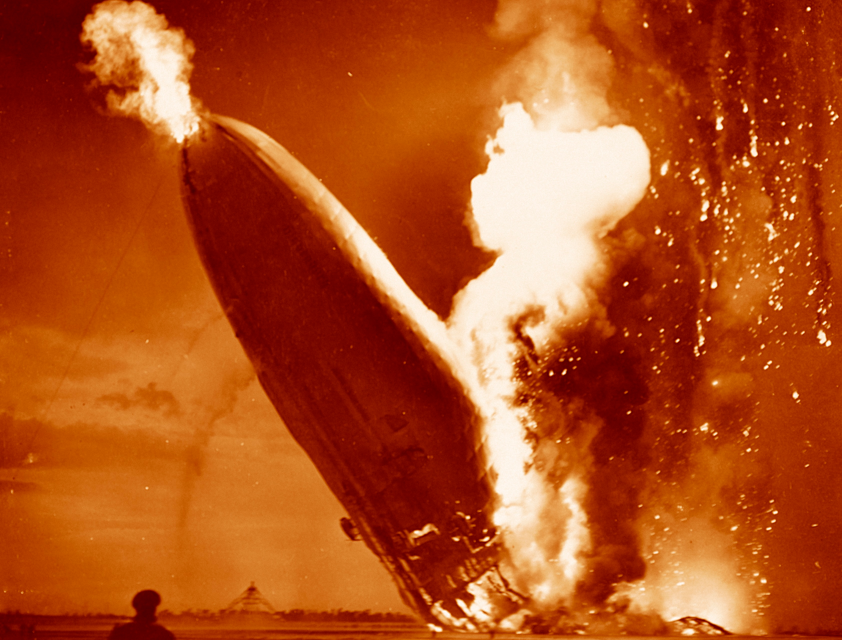
One of the finest illustrations of this was the highly emotional description by Radio WLS Chicago journalist Herbert Morrison of the arrival and explosion of the Hindenburg airship at Lakehurst New Jersey on May 6, 1937.
“What Morrison witnessed that night brought him to tears and no doubt the station’s many listeners too,” says Lynch.
Of course, live ‘on-the-scene’ reporting can also generate much lighter moments.
In 1975, during his days as a broadcaster on Melbourne’s 3LO, Lynch recalls being sent out by his producer to the Melbourne Show to describe the sensation of riding the Mad Mouse rollercoaster.
All went well until the car he was strapped into reached the top of the ride – and then suddenly plunged earthward.
Caught in a massive heart-in-the-mouth, G-force adrenalin rush moment, he exclaimed “BLOODY HELL!”
Not quite the sort of expression ‘Aunty’ was accustomed to back in 1975.
On their 3LO Drive program that same day, Graham Kennedy and Richard Combe chuckled “That was some live report!”
While older journos might lament the loss of these hands-on learning experiences for up-and-coming reporters, the question today is: Are they required for the journalists of the future?
Coverage of breaking news now comes largely via social media posts from other news sources – or from a member of the public who has a smartphone.
Breaking into programming to deliver a major headline used to be simple when the show was coming out of the one building.
With the rise of networked programs and voice tracking, now it’s complicated.
In a world where news has become so instantly and easily accessible – so visual, so constant and so global – the big question is: What can radio do with its limited budgets and human resources to stay in the game, let alone lead the way.?
Radio has assets, but is it using them to the fullest? The mobile phone has taken radio’s old transistor portability to a different level. It can go everywhere, just like the old transistors did, except it can report a story, not just broadcast one.
But it needs a human to do it.
Apart from the talent in the building, radio’s biggest untapped news resource is its audience. When there’s a crisis situation unfolding, talk radio can and does tap into the ‘person on the street’ to bring the story to life.
Talk radio does not have exclusive claim over breaking news, but what it does have is instant accessibility.
Even though networking is clouding that more and more, for the majority of the day, you pick up the phone and someone – dare I say it, even an on-air presenter – will answer.
What a concept.
Live and Local.
Easy to say. Harder to deliver.
But not impossible.
This article is brought to you by Radio Release.

Hindenburg image credit: Reuters
Related news
What's New
BY Sarah Patterson June 30, 2026
What's New
BY Sarah Patterson June 29, 2026



ARN always had the on the road reporter role but two years ago axed it. Very sad!
Agreed. A lot of stations talk about “live and local”, but the only real live and local is in regional stations 🙂
Great article by Radio Today! I miss the newsroom variety that came from the diverse metropolitan newsrooms in the 1990s. Things started to change around 1996/97 once I finished my Communications degree. I had the honour of working as an intern in the ABC radio newsroom in Ultimo in the mid-90s.
Between press conferences, it was my responsibility to monitor the 2UE & 2GB bulletins, and log their items into in the system for the Chief-of-staff to monitor their agenda. The ABC were like 2UE – they didn’t want to “miss a thing”. Meeting up with other journalists amongst the mix of microphone flags was a networking buzz!
My radio teacher at uni was the iconic ABC NewsRadio journalist and former 2KA News Director, Shon Walker. Shon prepared us for a season of cross-media ownership and shared resources in 96/97. The Austereo Triple M/2DAY-FM acquisition shared newsrooms, ARN bought ONE-FM and they moved to the same building as 2WS. In 1997, 2GB and 2CH newsrooms merged, and UE/GB newsrooms merged in 2015.
I have been with Australian Independent Radio News for 7 years and I am grateful AIR News has given me the chance to do what I dreamed of doing in 1996! The road of radio journalism has hit a cul-de-sac that now allows old and new journalists to turn their careers around and practice what they love – somewhere and somehow….if they are lucky!
This was a topic on Media Watch on monday night