What's New
BY Sarah Patterson June 3, 2026
What's New May 26, 2025
What’s in a name?
Reporter

Trust me, I’m a journalist doesn’t have quite the same ring to it as Trust me, I’m a doctor.
And yet – subconsciously or not – every time a radio newsreader opens their mic, that’s exactly what they’re inviting the listener to do.
Trust us.
You’d like to think that journos are not in the business of guesswork.
So what happens when we’re thrown a journalistic curve ball which suddenly makes us question the way we’ve always done something?

Sussan Ley didn’t just appear overnight. She’s been on the political scene for decades. Newsreaders have said her name countless times.
The quickest of checks confirms her surname is pronounced ‘LEE.’ Not ‘LAY.’
But when Ley this month became the first woman to lead the federal Liberal Party in its 80-year history, there was a spot of confusion as the ballot result was read out.
Cue journos all over the country saying “Hang on. Did they just say LAY? I thought it was LEE?”
If a government person said it, surely it must be right?
Do we go with Lay? Or Lee? Or do we just take a stab in the dark?
Sure, you might have a fifty-fifty chance of nailing it, but when it comes to one of the most prominent people in Australia, why would you even hedge your bets?
When you’re under the pump and on a deadline, it’s tempting to take the easier option and simply follow the pack.
This is where you need to trust your instincts and back yourself in.
Jump online and check.
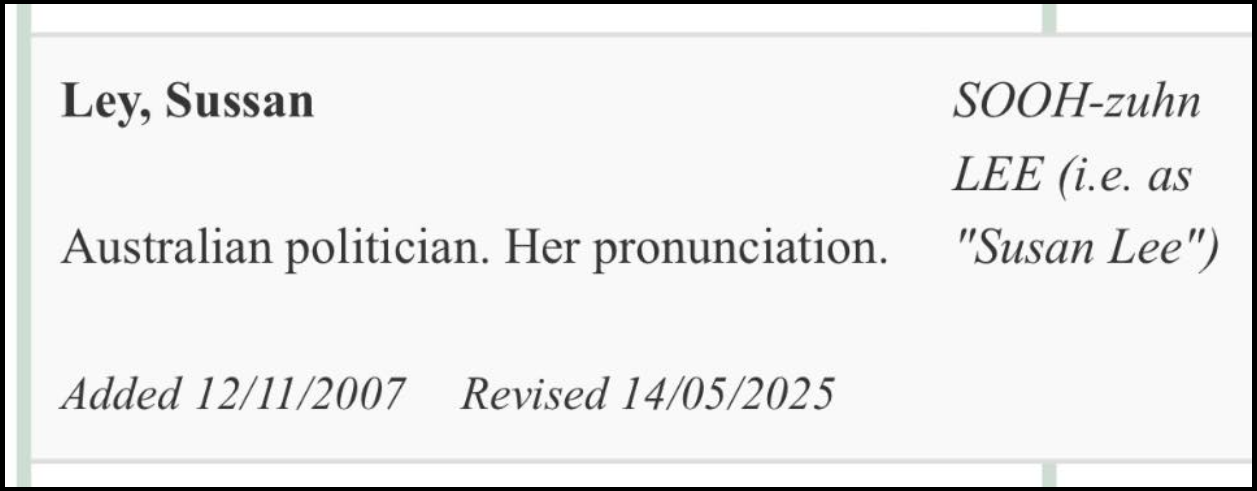
Funnily enough, on the day Ley won the Liberal Party leadership, the media seemed more interested in the cute little numerology story behind the spelling of her first name, rather than the correct pronunciation of her surname.
All of this reminds me of the time I queried a radio colleague over the way he said the name of a tennis player.
He replied: “He’s ranked 500 in the world. Does it matter?”
Cleary, to him, it didn’t.
I’d argue the player would feel differently. As would that player’s parents, siblings and friends, not to mention those who follow tennis.
That person whose name you’re guessing is somebody’s child.
That town you can’t be arsed about is somebody’s home.
Which brings me to the newsreader whose approach to pronunciations was: If you say it quickly – and with confidence – you can get away with anything.
There’s just one problem with this theory: Do you really want to get away with anything? Or do you want to get it right?
Sarah Patterson is a radio journalist of more than 30 years, former Breakfast News Presenter on Triple M’s Hot Breakfast with Eddie McGuire, WIN Television Bureau Chief, Radio Today Editor, podcaster and former News Director at Air News.
Related news
What's New
BY Sarah Patterson June 3, 2026




given the lack of checks balances and accountabilities within news, getting away with anything, would be about right
Great article Sarah,
I believe a lack of experience and mentoring is a problem in many newsrooms.
When I was a young journalists, I had many senior staff over the years who taught me many skills and helped me with pronunciation issues.
Many young journalists are now often put onto solo shifts and are expected to know and do everything.
Sadly, I think the exodus of experienced people frequently the industry will continue and probably increase.
When I worked at ABC radio in the 1960’s the “pronunciation guide” was the saviour.
Then again news and comment were not mixed either.
Locals versus people who think they know the King’s english, but just end up proving that they are not from these neck of the woods… Castlemaine !!! Tallangatta and Ballan.
It won’t be long before all news readers are A1 generated
It will be a good for stations because it will reduce costs
Name pronunciation is especially important at Vision Australia Radio. When I did my interview, I was given a sheet with a list of hard words and names. Some of those names included Xi Jinping, Annastacia Palaszczuk and Recep Tayyip Erdoğan. With well known people like the aforementioned names, a quick pronunciation check is easy and written down on the page for easy reference (but some readers still get it wrong in the heat of the moment). The hard surnames are the ones with various pronunciations based on where someone may be from (like Giannis Antetokounmpo having different pronunciations for native speakers from Greece, Nigeria or America. Everyone gets into heated debates over how that name is pronounced and Giannis has had to make highly-viewed YouTube videos explaining the various correct pronunciations of his surname). Some exotic surnames belonging to seldom-known, ordinary people can also be hard to figure out because you don’t have an easy reference.
@Amy
Reducing costs, but at what cost?
When I was teaching at university, I came across all kinds of family names from diverse backgrounds.
Examples include family names originating from Italy.
Baldachino pronounced Bal d’a keeno. The ‘ch’ is prounced ke. Some people wanted to have the mispronounced version ‘Baldacheeno’.
Mancini pronounced Mancheenie. The c before a vowel makes the ch sound.
In the media we’ve seen variations in pronunciations.
Scipione, a former police commissioner’s name, proper pronunciation ‘Schipy ornay’ rather than ‘Skippy oney’. I know a lot of people of Italian background screaming at the TV when his name was mispronounced as ‘Skippy oney’.
McKeon I have heard two pronunciations, ‘McKeeon’ and ‘McEwan’. I knew people who preferred the latter pronunciation.
O’Meara – a sporting personality pronounced as ‘O’Meera’ and a foodie journalist pronounced as ‘O’Mara’.
Palaszczuk, of possible Ukrainian origin. The proper pronunciation is ‘Palash’chook’. But the former Quuenland Premier Annastacia Palaszczuk was referred to as ‘Annastacia Pal o shea’. She may have preferred the latter pronunciation. How the ‘aszczuk’ translates to ‘o shea’ intrigues me.
St. John. Is it ‘Saint John’ or ‘Sin gin’?
In sum reporting on the pronunciations of names from diverse sources may warrant enquiry from the talent or talent’s representative before going to air.
The talent may well want the mispronounced version of their name because it may well be a hassle if they are constantly asked how to pronounce their name.
Nailed it Sarah . . . Says a lot about the so called ‘party’ minders attention to detail.
If they can’t get her name right in house, what hope do the journos have when it’s reported in news stories.