What's New
BY RadioToday Network June 5, 2026
What's New July 17, 2025
Generative AI is reshaping how consumers discover news
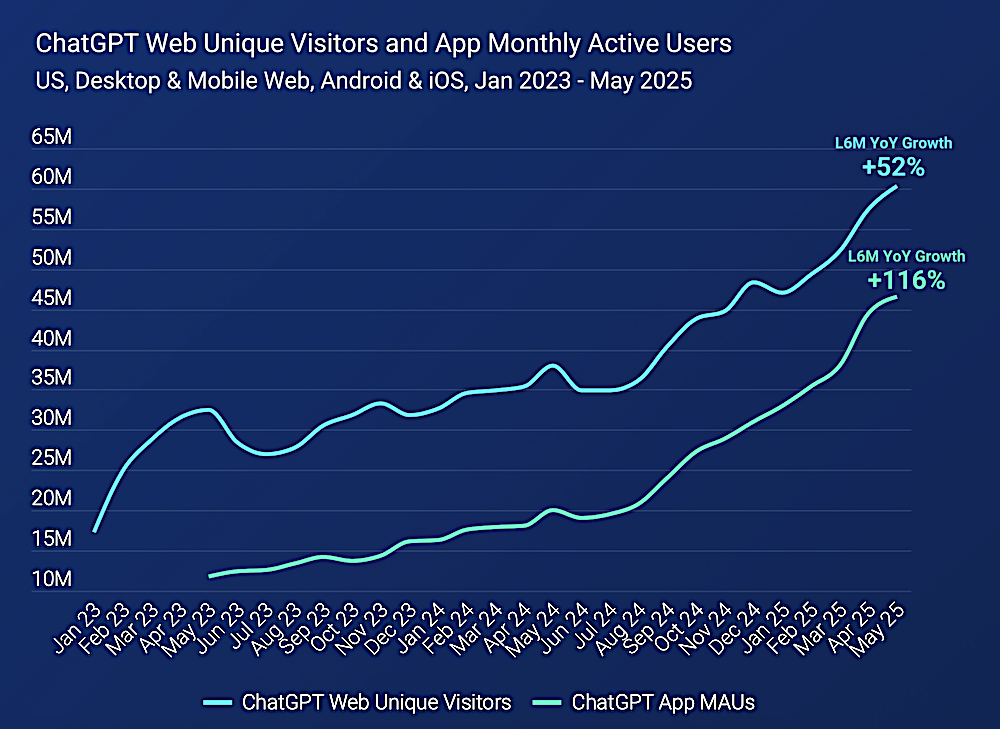
A new study by Similarweb confirms the continuing click theft trend happening to news publishers.
As users shift from traditional search to AI tools like ChatGPT, they are seeking faster, contextual answers to complex and evolving topics – from market trends to policy developments.
As a result, news-related prompts on ChatGPT and ‘zero-click search’ have surged, while organic traffic to publishers has declined.
AI is changing how news is accessed and redefining distribution dynamics.
As ChatGPT, Perplexity, Grok , Claude, CoPilot and others reshape the internet, Google’s search dominance is being challenged and searchers are beginning to change their habits. The Similarweb research found that active users to ChatGPT are growing fast.
The dilemma for publishers is whether to adopt strategies to maximise ‘share of prompt’ search results, risking the bots summarising their content without any click-throughs, or to lock content behind a paywall or a bots-block command, risking that the content will never be surfaced in AI searches.
If you are trying the second strategy of blocking bot scrapers, be aware that there are two commands in the robots.txt file that you can use. You can still block AI Bot Scrapers, without blocking Search Bots. Also be aware that some of the more unscrupulous AI scrapers ignore no-AItraining commands even if you put them in your robots.txt file.
ChatGPT surges as a source for news, Google drops

Between January 2024 and May 2025, news-related prompts in ChatGPT rose by 212%, while equivalent Google searches declined by 5%. It seems that search users are learning how to compose questions and prompts that will deliver the answers they want from generative AI tools.
Generative AI tools are being used most for news updates on common topics that can deliver simple instant answers, such as sport scores, finance markets and weather.
It makes sense that these would be the most popular and easy to access, because the news is simple and needs little interpretation, so trust in the results is less of an issue. But what about news topics that do need some kind of interpretation from a journalist or editor? These too are being searched by AI, but in smaller numbers. The most popular topic in the research was Economy, followed by Politics then Tariffs, reflecting the American president’s ability to hijack the world’s daily news cycle with another thought bubble about his tariff obsession. The other topics are listed in the chart below.
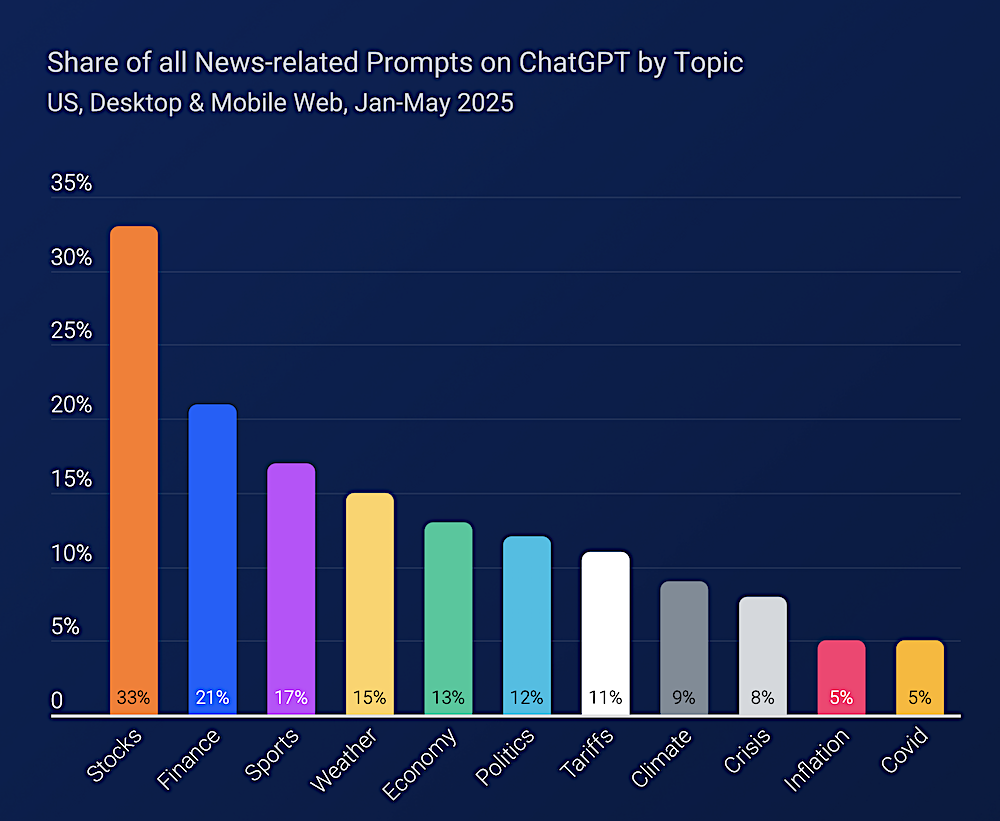
Frightenly for news publishers is the trend that the topic Politics is the fastest growing ChatGPT search topic. The easy daily topics such a stocks and sports scores still get a higher share of traffic, perhaps because people are experimenting with topics they can easily check to work out if they can trust ChatGPT for news. The fast growth of the Politics topic may mean that searchers will soon be using their generative AI bot to inform them about who to vote for.
Referrals from ChatGPT to news publishers jumped from just under 1 million in Jan–May 2024 to more than 25 million in 2025. Publishers like Reuters, The New York Post and Business Insider, The Guardian and Wall Street Journal have emerged as major beneficiaries of that trend. This data also indicates the dominance of American searchers across the internet. With almost universal conectivity in America and a huge English speaking tech savvy population, it is unsurprising that American search trends dominate the research results of Similarweb (which is also an American listed company). With results skewed by American consumptionn data, there is increased liklehood that companies based elsewhere in the world will not be easily surfaced by AI Bots because they don’t have the same visibility to the bots as websites with more traffic. The Data Bias favours American websites and information content.
Click theft
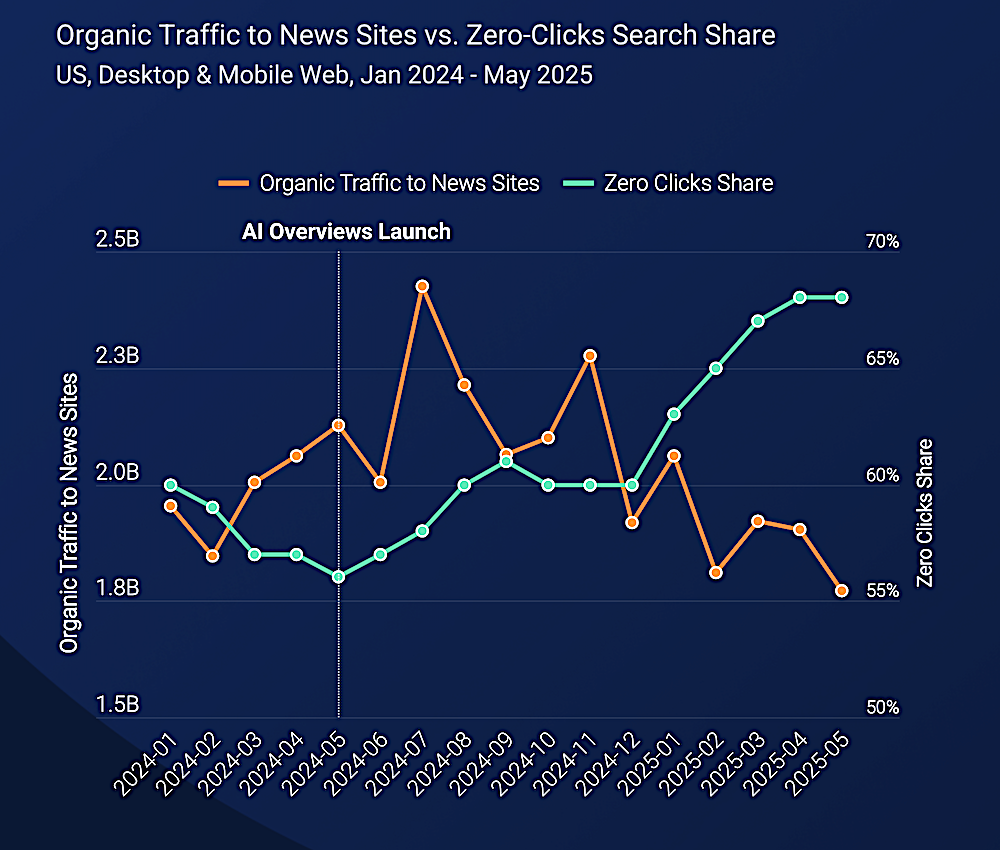
Share of zero-click news searches has steadily increased, resulting in a noticable decline of organic traffic to news publishers, dropping from over 2.3 billion visits at its peak to under 1.7 billion as of May this year.
The Similarweb research concludes “visibility alone may no longer translate into traffic, challenging long-standing assumptions about the value of ranking in search.”
| About the Author: | |

|
Steve Ahern is the managing editor of this trade publication and CEO of the training company AMT Pty Ltd.
Steve will be speaking about AI trends for broadcasters and publishers at two upcoming conferences: Asia Media Summit in Cambodia next week and RadioDays Asia in Jakarta in September
|
Recent comments (0)
Post new comment