What's New
BY RadioToday Network June 4, 2026
What's New March 11, 2025
AI use in radio: Where do we draw the line? #RDE25
Reporter
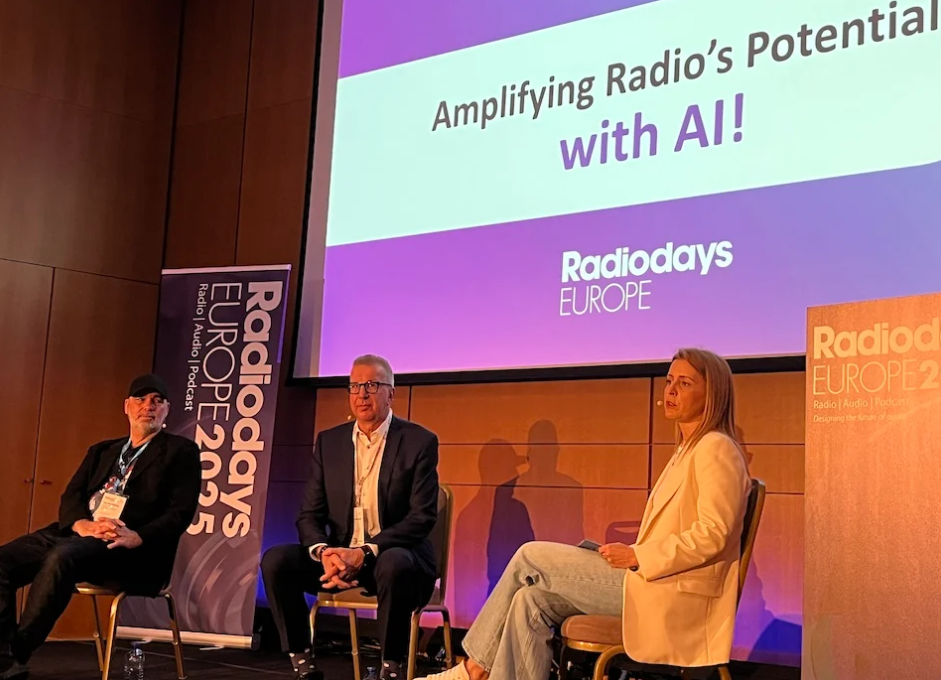
“Do we want to hire a human being? Radio is about the human connection. We will need to decide.”
With radio stations worldwide having become the early adopters of Artificial Intelligence and growing interest in the use of AI for both music and information content, Nick Dunkerley from tech company Hindenburg posed this timely question at RadioDays Europe.
Do we want the tail wagging the dog?
Put simply, it all comes down to choices.
“This is a discussion about humanity and we as journalists and producers will need to make informed decisions about how we use AI. Let’s put effort into the quality of our work so that people will know this was made by a human being.”

Here in Australia, SCA has utilised AI in its AdTech Hub and in its regional weather reports, with CEO John Kelly (pictured above) recently telling RadioInfo “Say for Fuel Watch – which highlights individual locations which have cheaper fuel – or Weather Watch … we use it more in that field at the moment.”
Kelly went on to say “We’re in the early days, but I think AI has a future, and we’ll continue to examine that, and it’s becoming more mature. But we, like others, are at the test and learn stage.”
At RadioDays Europe, Dunkerley and Philippe Generali from fellow technology supplier RCS discussed how they’re integrating AI into their software.
They also talked about where the balance should be between AI and human intelligence.
In terms of music scheduling, the next step for RCS is adding AI and ChatGPT to bring the next stage of evolution.
“Today, radio has fewer radio Program and Music Directors controlling more channels. How do you handle the playlist for maybe 100 stations? You can’t possibly be looking at all the activities of every station’s schedule,” said Generali.
“At RCS, we are introducing the music scheduling in the cloud that will handle all the data points that you have access to as a Content Director. It will go to the next step for you. The AI might say to you, that song seems to be getting lots of play in the outside world. It will show you the trends, it will analyse the fan base of the artist and the song.”
“It can link all those data points and suggest to you which songs may have the chance of becoming a number one hit, then help you to program them into the appropriate schedules.”
Dunkerley looked at how AI might be a useful tool for journalists.
Whilst it can aid with research and offer new ideas on topics, Dunkerley advised serious journalists not to hand over responsibility to AI.
As an example, he played a realistic-sounding radio chat about the history of music between two presenters. It still sounded plausible and had some information in it, but, according to Dunkerley, it was audio filler ‘crap.’ It didn’t really connect with the audience and the presenters didn’t seem to connect with each other, or the material that they were discussing.
“AI is good at background research, audio clean up tools, faster more productive workflow, but we should always be thinking about the quality of the output,” said Dunkerley
AI, he says, can make it easier and faster for journalists to enhance the audio quality of their output.
“We are using it to remove many obstacles for journalists to be able to focus on quality reporting, but they should use the extra time they gain from these tools to do better research.”
“If there was ever a time when we need journalists to dig deeper into what is happening, it is now!” Dunkerley said.
“AI can throw out hours and hours of content but is that what we should be using AI for? We have to make ourselves better, we need to be directing the path of our stories. If we don’t better ourselves, we will be irrelevant.”
He advocates safe and smart adoption of AI in radio.
“At Hindenburg, we make sure we have the option for an offline system. The problem with having critical sensitive information in the sky, such as confidential sources, is that you don’t know who can access it.”
Generali said RCS while clients are asking about synthetic voices, they are not planning to replace the traditional DJ.
It’s more about using a synthetic voice to say the station name and weather to make it sound local when a program is heard on many stations.
Generali said the program is still live, but the listeners to each station will hear the presenter’s voice giving them the local callsign, local weather and other program elements that need to be localised.
“I don’t think synthetic voices are ready yet to replace human beings.”




Using AI to present localised weather reports, is a disgrace. You could pay someone another couple of hours to present weather for all markets and they would develop a passion for local. If there’s ANYBODY still sitting in a metro radio station, offer their kids a feed at TGIF to do it. I mean you guys really are sinking low now. If you aren’t going to be proper local, please please please be proper human.
“You can’t possibly be looking at all the activities of every station’s schedule”? Yes you can, employ Australians.
It’s a matter of time! AI is a bloody annoying game changer, but it is here to stay and slay. As time goes on it will get better and better.
Well hot dog! We have a weiner!
announcers are already on the way out like wise , copywriters , news will be next